
Credentialing
How to grow your therapy practice by January: build your credentialing plan
Want to grow your therapy practice by January, but unsure where insurance fits? A payer application alone cannot promise new clients or a January start.
Choose a product your community needs, confirm its panel, then prepare for the payer’s process. Use two questions to find the next useful check.

Start with the access barrier
Growing a therapy practice starts with understanding why suitable clients do not book. If local inquiries repeatedly mention insurance you do not accept, investigate that access barrier. If people cannot find your practice, improve discovery and referrals. If appointments are unavailable, review capacity. Credentialing addresses a payer relationship; it does not solve every growth problem.
Make the insurance question specific. Which product do people ask about, in which service area, and for which care? Keep notes anonymous. A short list grounded in referral conversations is more useful than applying to familiar brands without knowing whether their networks fit your practice.
- DiscoveryCan people find you?
- AccessCan they use their plan?
- CapacityCan you offer an appointment?
Choose the product, then check the panel
One insurer can operate several products and networks. Record the exact product, clinician, practice entity, provider type and service location. Ask the payer whether it is considering applications for that combination. A colleague’s enrollment or an online directory entry is not confirmation that the panel is open to you.
Aetna’s network FAQ distinguishes credentialing from contracting and describes network need by area. Other payers have their own processes. If a panel is closed, ask about its current waitlist or review route rather than assuming a different application will bypass the decision.
Prepare without promising a date
Use January as an organizing target, not a promised approval date. Once the payer confirms its route, check its current document requirements. These may include a license, malpractice coverage, NPI information, W-9, CV and CAQH information where required. Confirm that clinician, practice and location details agree across the records.
Give each application an owner and a next follow-up date. Keep requested documents, submitted status, credentialing decisions, contract terms and written effective dates separate. An application is not an approval, and an approval does not necessarily mean participation is effective. Do not advertise in-network status before the applicable written confirmation.
- ApplicationRequested information sent
- Decision + contractConfirm each in writing
- Effective statusVerify before in-network claims
Keep the January context in perspective
The supplied graphic reflects a historical American Psychiatric Association poll: 38% of adults planned mental-health-related resolutions for 2026, including 58% of adults aged 18–34. Its 2,208 adults were surveyed December 2–3, 2025. Those intentions are not booked appointments or a forecast for the coming January.
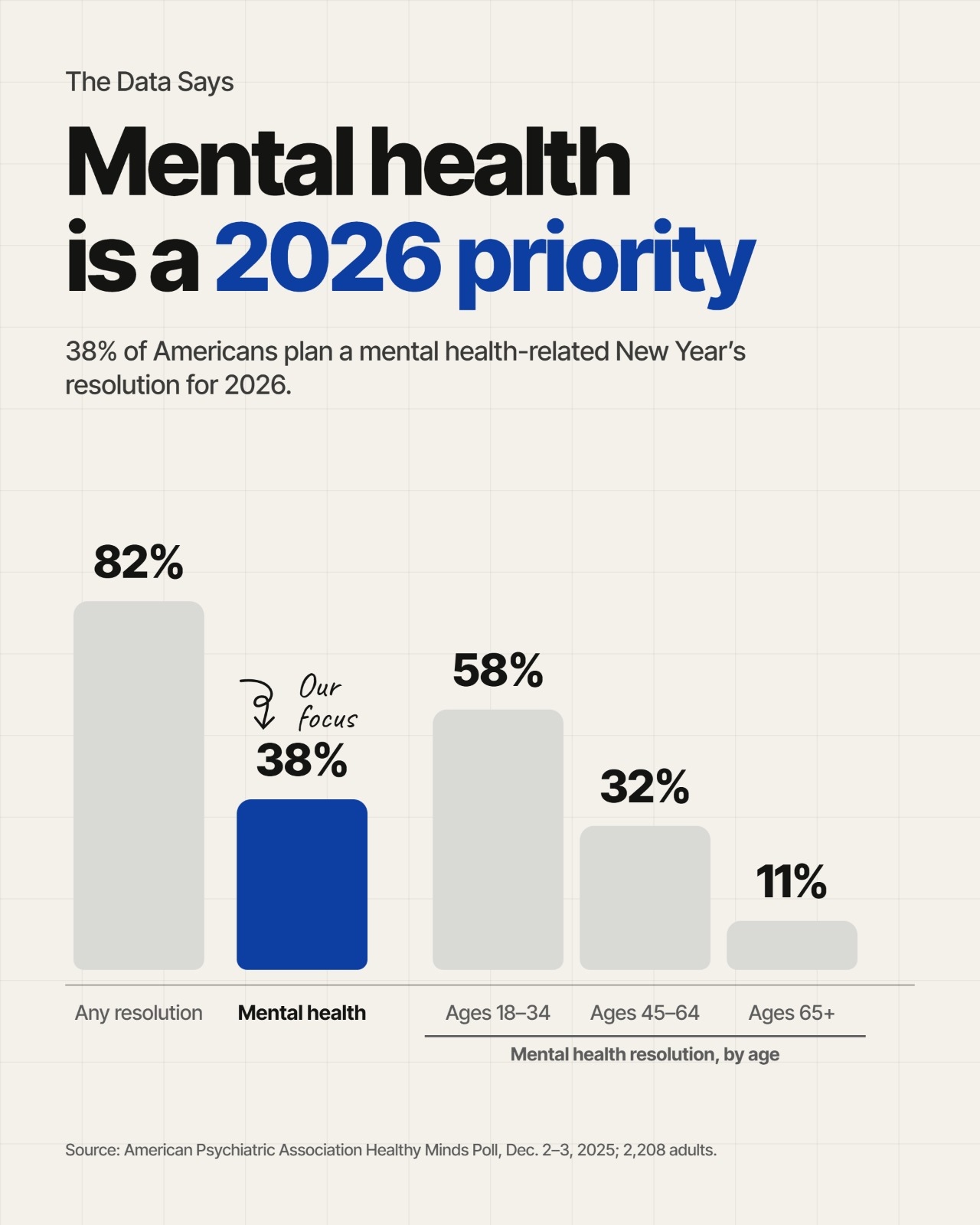
Historical 2026 intentions—not current therapy demand, payer availability or predicted practice results. Your own inquiries and referral patterns are the more useful starting point for a payer shortlist. Keep answering suitable inquiries and maintaining referral relationships while enrollment work proceeds; joining a network does not replace that work.
Review the work before expanding
Before accepting an offer, examine its actual written rates, covered services, terms and ongoing administration. Consider whether your practice can sustain that work. A directory listing may improve visibility, but it does not guarantee referrals, reimbursement or a full schedule. Keep unconfirmed facts visible instead of building them into revenue assumptions.
If demand later exceeds capacity, review appointments, budget, supervision and staffing before hiring. An additional clinician may need individual enrollment or a group association; the practice’s current status may not cover them automatically. More clinicians create capacity, not demand. Use demonstrated need rather than a seasonal expectation to guide the decision.
- Evidence of demandActual inquiries and referrals
- Capacity decisionAppointments, staffing and budget
Find your next January planning step
You do not need a complete growth forecast to move forward. Start with the biggest unresolved fact: the exact product, its panel status or the application requirements. Leave uncertainty visible rather than guessing to finish a plan. The two-question check below turns those answers into one next action without collecting contact details or sending an application.
Sources and scope
This is practice-planning education, not a promise of January completion, network approval, referrals or revenue. Confirm current requirements, written terms and effective status for your exact practice.
January planning · Question 1 of 2
Have you chosen a payer?
Think of one exact insurance product or network, not only the insurer’s brand.
Editorial details
- Author
- Phorzen — Credentialing education team
- Reviewer
- Adapted from the owner-supplied January article. Sources checked November 21, 2026; no independent clinical, legal, or financial review is claimed. Payer requirements and participation status must be verified for the exact practice.
Sources and references
- More Americans Plan Mental Health Resolutions Heading Into 2026 — American Psychiatric Association
- Joining the Provider Network FAQs — Aetna